
Table of Contents
AI Tutor vs. Human Teacher: What Really Works for Learning a Language
Sapere's team

For a long time, learning a language meant choosing between lessons with a teacher or studying on your own with books and exercises. Today, a third option has become unavoidable: AI. Some see it as a replacement; others as a gimmick. In reality, the most useful question isn’t “who’s better?” but “who’s better at what?” Because language learning isn’t a single skill—it’s a mix of comprehension, speaking and writing, memory, confidence, motivation, and the ability to handle real-life situations.
A human teacher and an AI tutor each have very clear strengths—and very real blind spots. For most learners, the most effective approach is to organize a collaboration: give each one the tasks they excel at, and avoid asking them to do what they’re weakest at.
What Humans Do Better Than AI
A good teacher doesn’t just explain a rule. They read the learner: hesitation, habits, fears, fatigue, motivation that day. That very “human” part is central in language learning. Two people can have the same grammar level and yet feel completely different in speaking—because one dares to speak and the other doesn’t. During conversation, a teacher knows how to create a space where the learner feels safe enough to take risks. And that’s exactly what drives progress in speaking.
Teachers are also excellent at smart correction. They don’t correct everything: they choose. Correcting every mistake can discourage someone; correcting nothing can lead to stagnation. A human knows how to prioritize: today we focus on key sounds, tomorrow on question structure, later on vocabulary precision. They can also explain why something sounds “off” in a cultural, professional, or relational context.

Finally, in a professional setting, a teacher brings something that’s hard to automate: training for real situations with nuance, implied meaning, and communication strategy (how to rephrase, buy time, clarify without losing face, handle disagreement). AI can simulate—but a teacher often understands the human stakes of the scene more deeply.
Limits on the Teacher Side
The problem isn’t quality… it’s scalability. A teacher has limited time. One session a week helps, but it’s not enough to truly anchor a language if the learner doesn’t practice between lessons. And teaching styles vary: depending on the instructor, methods can differ, and it can be hard to measure progress precisely without structure and consistent follow-up.
Also, some learners don’t want to repeat the same thing 20 times in front of someone. They need a “no-judgment” space to train.
What an AI Tutor Does Better (And Why It Became Popular)
AI shines when you need volume, repetition, availability, and fast personalization. It can generate on-demand exercises, explain the same concept in three different ways, create 15 targeted examples for a specific error, or keep a dialogue going endlessly. Where a human is constrained by time, AI can support daily practice—and that’s decisive. With languages, frequency often beats intensity.
It’s also great at adapting content. One learner works in finance, another in healthcare, another in customer service: AI can create scenarios, vocabulary, micro-texts, and questions centered on the job. That contextualization speeds up memorization and gives an immediate sense of “ROI”: you’re learning what you actually use.
Another advantage: AI is a powerful tool for unlocking learners. Many people dare to speak more with AI than with a human, especially early on. It’s a training zone where you can test, make mistakes, restart—without social pressure. For pronunciation, listening, and repetition, that freedom is precious.

For the general public, it’s also simply practical: you can practice for 10 minutes during a break, on the bus, or in the evening. And you can repeat as much as you want without feeling judged.
It’s also helpful for everyday “small problems”:
rephrasing a sentence before sending a message,
finding more natural expressions,
practicing a mini-dialogue (restaurant, travel, interview),
reviewing that grammar point you always mix up.
For many people, AI plays the role of a close-range coach: it makes practice possible even when you don’t have the time or energy for a “real session.”
Limits on the AI Side
AI can be wrong, oversimplify, or give an explanation that sounds plausible but doesn’t fit the context. Even when it’s correct, it often struggles to prioritize: it may correct too much, or not in the right way for that learner in that moment. When someone finally dares to speak and AI highlights every single mistake, it can be demoralizing.
There’s another big limitation: AI doesn’t truly feel the situation. It can simulate a conversation, but it doesn’t always pick up the emotional layer, the relationship, the power dynamics (client, manager, colleague), or the implicit goals. AI may go too straight to the point—or, on the contrary, pile on politeness—without knowing how to calibrate.
Finally, without a framework, AI can encourage “floating” learning: you do exercises, but you’re not necessarily building a coherent progression. That’s where many learners get lost: they practice… but not strategically.
Why Hybrid Is Often More Effective
Hybrid works because it combines two things that—together—create solid progress:
Human and pedagogical precision (teacher)
Frequent, personalized repetition (AI)
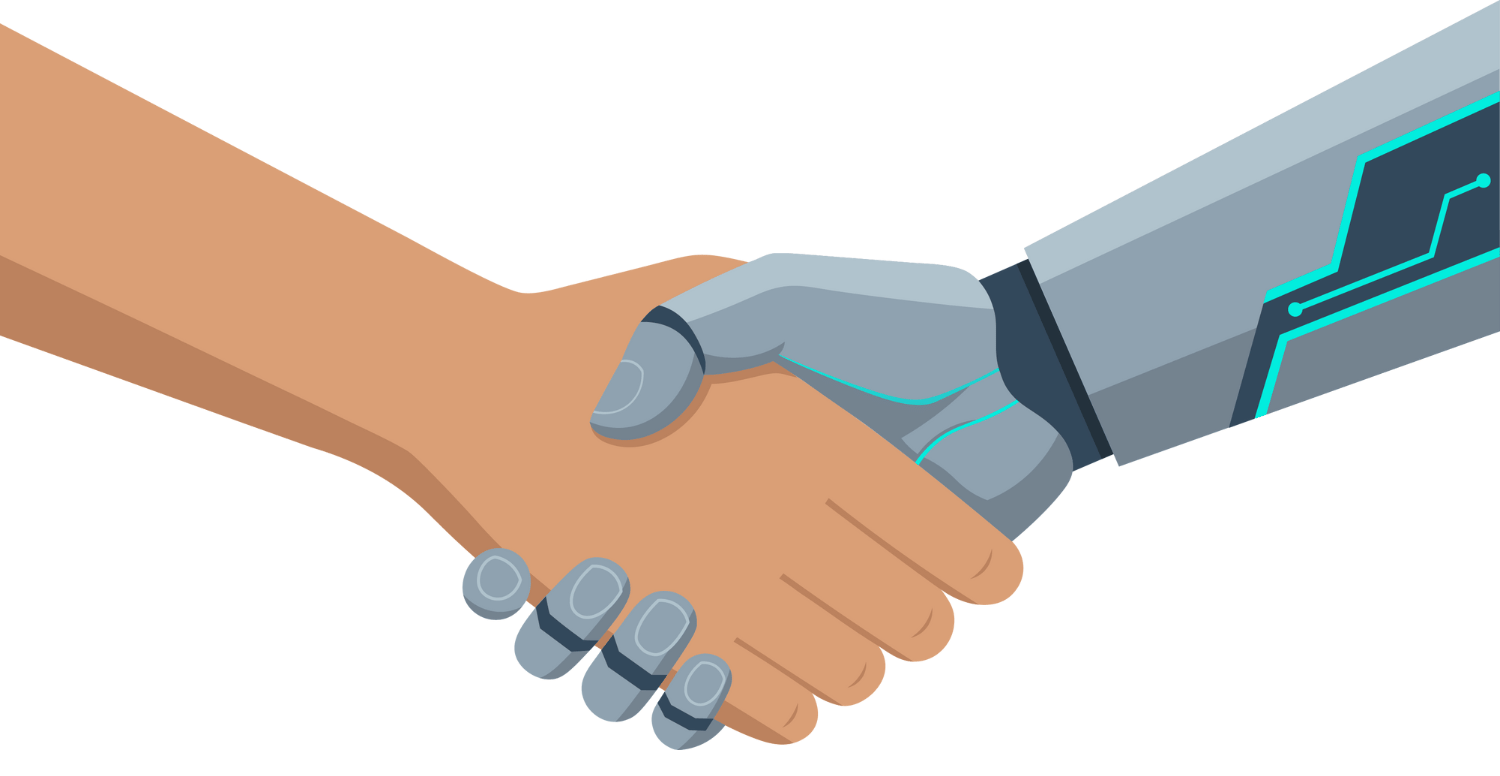
In practice, the teacher becomes the conductor: they diagnose, set priorities, correct what truly blocks progress, and train the complex skills (real interaction, nuance, persuasion, confidence). AI becomes the training engine: it multiplies repetitions, automates drills, reinforces job-specific vocabulary, and keeps practice going between lessons.
Instead of “replacing” the teacher, AI supports them: it saves them from spending time on repetitive tasks (generating 30 training sentences, correcting basic drills, creating endless variants). Result: scarce human time is used where it has the highest impact.
A Role Split That Truly Works
Take a sales / account management team with employees who want to be persuasive in English—not just “correct.”
In this international sales team, employees can get by in English, but struggle to be impactful: explaining value, handling objections, negotiating a point, following up without sounding too direct. They’re not only trying to speak without mistakes—they want to sound credible and master the codes.
Here, the teacher acts as a coach: training for meetings (discovery call, demo, follow-up), work on message structure (30-second pitch, storytelling, open questions), and fine-tuning register (tone, diplomacy, framing objections). They also adjust strategy based on the person’s style (more reserved, faster-paced, etc.).
With the teacher (one session per week or every two weeks):
You work on high-stakes situations (presenting an idea, interrupting politely, clarifying a misunderstanding, handling an objection). The teacher corrects the “root” errors and sets 2–3 priority goals.
AI becomes the daily training room: simulating tough questions, generating pitch variants tailored to the product, rephrasing follow-up emails, repeating negotiation phrases, and doing “cold practice” before an important call. The typical result: learners gain fluency and impact because they repeat far more than a course alone would allow.
With AI (10–15 minutes per day):
You train those goals precisely through repetition and variants: rephrasing, mini-dialogues, sector vocabulary, micro-assessments, and pronunciation drills on troublesome sounds.
And to ensure long-term progress, you build hybrid learning like Sapere, where the teacher uses AI to provide personalized exercises and uses completed exercises to give precise feedback.
In hybrid, the human explains the results:
The learner shows the teacher a completed exercise (reading comprehension, multiple choice, or a pronunciation recording). The teacher checks accuracy, clarifies what remains unclear, and adjusts the learning strategy. That way, AI can adapt future exercises—and you avoid the trap of “I do a lot, but I don’t know if I’m improving.”
This system works because it creates continuity: the human session sets direction, AI provides practice, and everything stays measurable.
Pitting “AI tutor” against “teacher” is tempting, but it’s often the wrong question. AI is excellent at making practice frequent, targeted, and accessible. A teacher is irreplaceable for human support, strategy, nuance, and well-calibrated correction. Maximum effectiveness appears when you stop choosing sides and build a duo: a teacher who leads, and AI that powers the training.
Similar Tags
Popular Keywords
Related Posts