
Table of Contents
Why Do We Forget What We Learn? Our Strategies for Long-Term Progress

Sapere's team

Learning a language is not just about memorizing some vocabulary words and an introductory sentence. The real challenge is retaining it long enough to reuse it in a meeting, in an email, during a conversation, or when dealing with a demanding client. That is exactly where many learners become discouraged: they feel like they are learning… and then forgetting almost immediately. This phenomenon is normal, has been documented for a long time in cognitive psychology research, and has a well-known name: the forgetting curve.
At Sapere, we believe the problem is not that learners “have a bad memory.” The real issue is that learning is too often treated as a one-time event, whereas durable memory requires targeted review, active practice, and a good dose of personalization. That is why the Sapere platform offers personalized content, exercises generated according to the learner’s profile, contextualized activities, smart flashcards, and tailored assessments.
What is the forgetting curve?
The forgetting curve comes from the work of German philosopher Hermann Ebbinghaus (published in 1885) and describes a simple idea: without reactivation, a significant portion of what we learn fades quickly, especially in the first moments after learning. The decline is generally steeper at the beginning, then slows down over time. Recent studies continue to confirm the existence of this general phenomenon, even if the exact figures vary depending on the task, the type of content, and the way it is learned.
In short, Ebbinghaus proved that we retain information longer if we review it regularly. On the curve below, we can see that after learning something (a vocabulary list, for example), we retain only 28% of it after 24 hours. But if we review it the next day, we retain 65% after 24 hours.
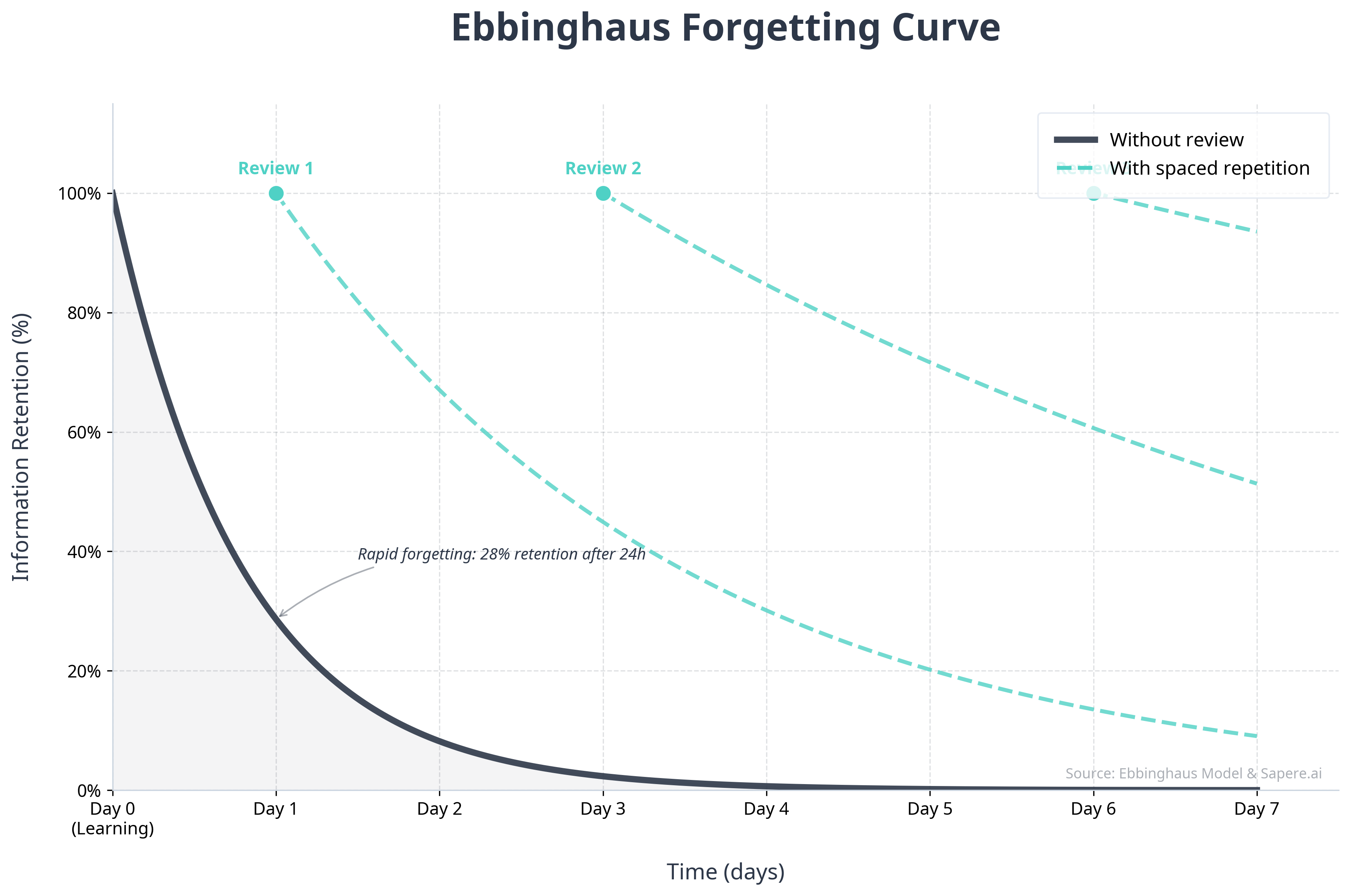
In other words, reading a grammar rule once or seeing a new word in class is not enough to retain it. If that word is never reviewed, reused, recalled, or placed back into a concrete context, it has little chance of becoming firmly established in long-term memory. This is especially true in second-language learning, where the learner must not only recognize a form, but also know how to understand it, produce it, and use it at the right moment.
Why do we forget so quickly in a second language?
Because we confuse exposure with durable learning. Seeing a vocabulary list, rereading notes, or highlighting a document can create an impression of mastery, but research shows that these methods are often less effective than strategies such as retrieval practice and spaced repetition. In a major research synthesis, John Dunlosky and his colleagues ranked practice testing and distributed practice over time among the most useful approaches, while rereading and highlighting were found to be far less effective.
In language learning, another factor makes things more complex: we rarely learn a word or structure in isolation. We also need to remember the context, the register, the pronunciation, the collocations, the cultural nuances, and the production automatisms. That is why generic learning tends not to last as well as learning tied to a real-life situation: welcoming a client, writing a follow-up, taking part in a meeting, describing an incident, explaining a procedure. Sapere places a strong emphasis on this vocabulary and these contextualized tasks according to each learner’s profession, level, and goals.
What does learning science say about retaining information better?
Recent work in the learning sciences converges around a few robust principles. Two stand out in particular: spacing out reviews and retrieving information from memory (that is, pulling information from memory in order to apply it during a test or presentation) rather than simply rereading it. A 2022 study in Nature Reviews Psychology highlights that spacing and retrieval practice improve learning across many domains and at different ages.
The spacing effect shows that we retain information better when study sessions are spread out over time rather than grouped into a single block. Even with school-related content, spacing lessons improves not only memory but also the generalization of knowledge. In language learning, this can translate into a varied weekly routine, for example: vocabulary on Monday, speaking practice on Thursday, and exercises on Saturday, rather than learning only vocabulary for one week and then doing only conversation the following week.
Retrieval practice, on the other hand, consists of trying to pull an answer from memory: recalling a word, completing a sentence, reformulating a rule, answering a question, or taking a mini-test. This simple effort of recall strengthens future access to the information more effectively than passive repetition. Research even shows that the advantage of active recall over simple repetition can persist over the longer term.

Our practical strategies for making long-term progress with Sapere
Review for less time, but more often
The classic reflex is to do one big one- to two-hour study session once a week. For memory, that is not ideal. It is often better to multiply short review sessions: 10 to 20 minutes several times a week, especially after a first exposure to a concept. The logic behind Sapere follows this principle: enabling flexible, frequent practice that is integrated into daily life rather than limited to one fixed moment.
In concrete terms, a learner can review their personalized lexical field on Monday, do a few targeted exercises on Wednesday, then complete an oral or written activity on Friday. This rhythm creates several opportunities to reactivate the same elements in different forms. Sapere supports this continuity with its Learn, Practice, and Evaluate sections, which make it possible to return regularly to important concepts.
Use smart flashcards to fight forgetting
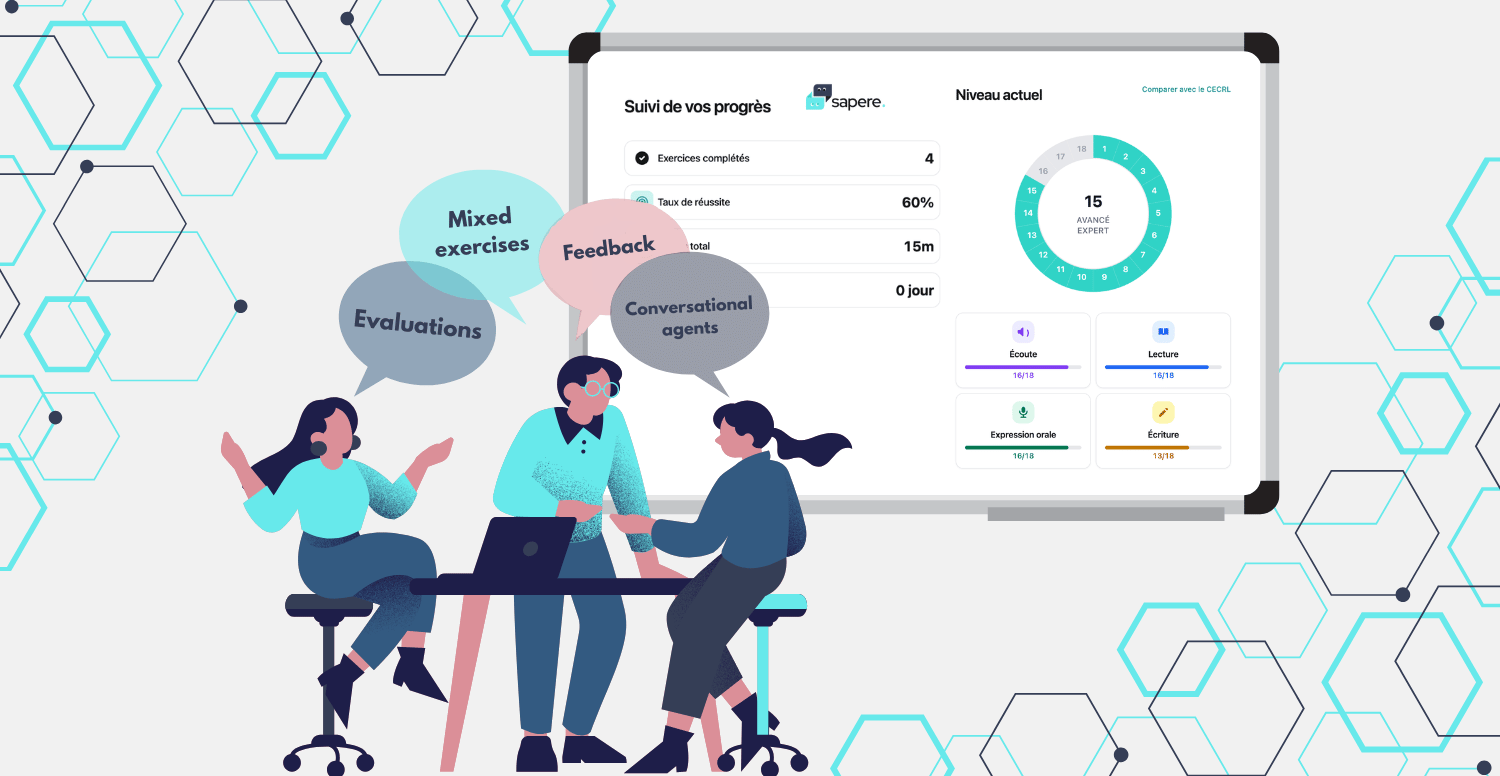
Flashcards are particularly well suited to the forgetting curve because they force you to test yourself rather than simply reread. Sapere’s flashcard module was designed specifically to speed up vocabulary development in a way that is more effective and better adapted to the learner’s level. In fact, the cards do not simply give you a word’s definition: they can also help you review terms through images, antonyms, gap-fill texts, and more.
The goal is not to pile up hundreds of words out of context, but to review vocabulary that is genuinely useful for your work and your goals on a regular basis. A customer service learner does not have the same needs as a nurse, a manager, or a technician. When review is built around targeted vocabulary, it becomes more motivating and more memorable.
Prioritize active recall over simple rereading
When you reread a rule and it feels familiar, you may think you know it. But that impression is misleading. A better strategy is to put the lesson aside and try to produce the answer yourself: conjugate a verb, reformulate a structure, translate a sentence, complete a gap-fill exercise, or answer a question. This is exactly the kind of work Sapere’s personalized exercises make possible.
For example, instead of rereading five times a list of expressions for leading a meeting in English, the learner can generate exercises or a simulation activity in which they must retrieve the useful phrasing themselves. In this way, they move from passive recognition to real language mobilization. It is more demanding in the moment, but more effective for retention. As we explain in our article on Krashen’s theory, it is important to complement “input” with “output” or, in other words, to use what you have learned.
Relearn in a professional context, not just in theory
Memory retains meaningful content more effectively. An abstract word learned from a list is forgotten more quickly than a word reused in a credible and useful situation. That is why Sapere personalizes content according to the learner’s professional field, level, and goals, instead of offering the same path to everyone.
A simple example: learning “to follow up,” “deadline,” “invoice,” or “safety procedure” in a work-related scenario increases the chances of future reactivation, because those words will later be encountered again in emails, role plays, activities, or conversations connected to your reality. This contextualization is at the heart of Sapere’s immersive activities, which place the learner in real-life situations.
Vary the formats to strengthen the memory trace
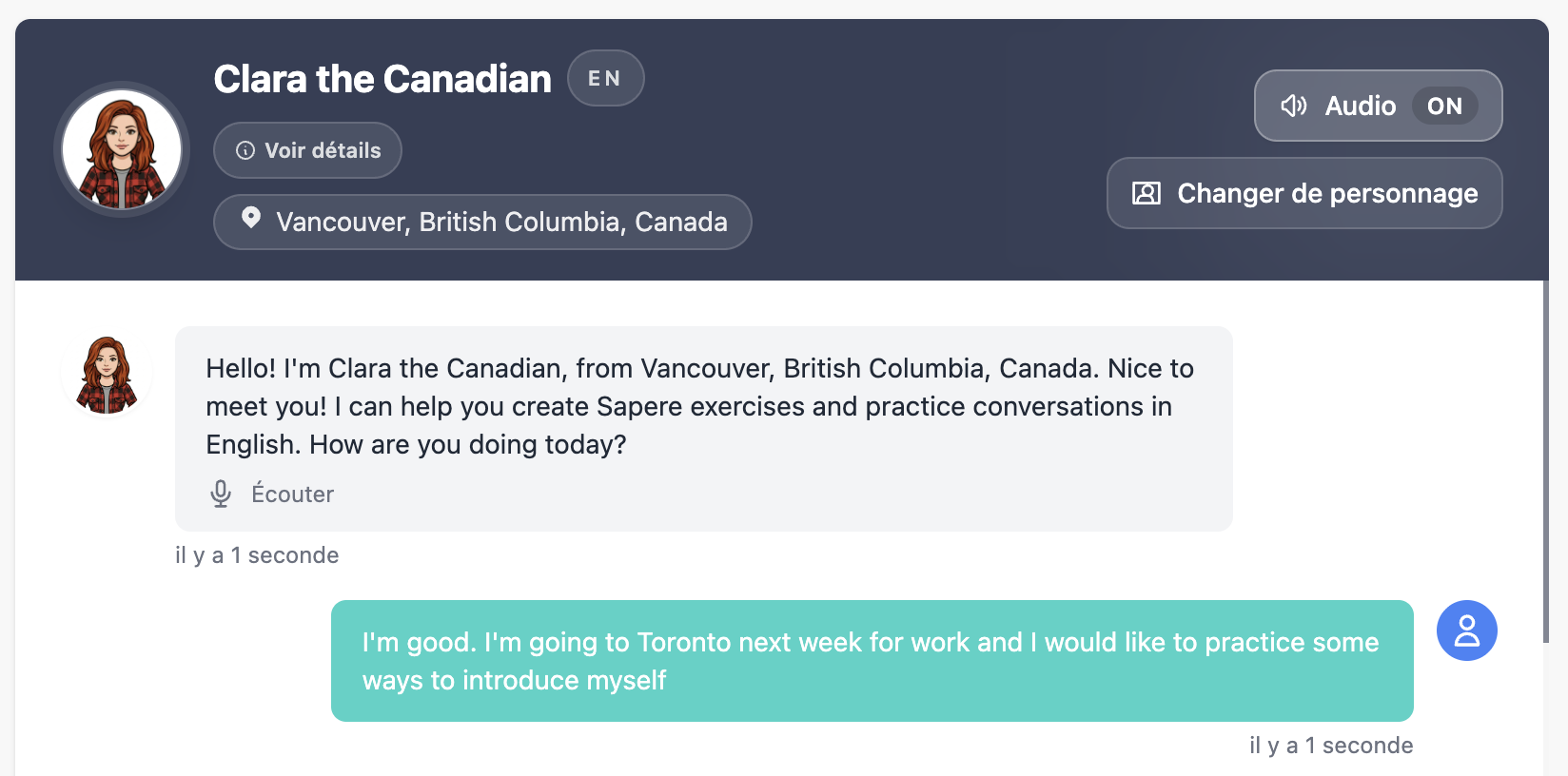
Research does not just say that lessons need to be reviewed; it also suggests that it is useful to review them in different ways. When the same content is activated through reading, writing, comprehension, and production, it is more likely to stick. Sapere makes it possible to move from a lexical field to an exercise, then from a conversation to an activity, and finish with an assessment.
Take a structure such as “I’m following up regarding…”. It can be learned in a lexical module, practiced again in a gap-fill exercise, reused in a professional email, and then brought back in a conversation with our conversational agents. Each act of recall adds another layer of solidity to learning. This variety also helps prevent fatigue.
Use assessment as a learning tool
Many people see assessment as a final measure. In reality, in the learning sciences, simply trying to retrieve information from memory is already a way of learning. Tailored assessments and targeted exercises can therefore play a double role: measuring progress while also consolidating what has been learned.
In Sapere, the Evaluate section is specifically designed to revisit skills that have already been worked on. This return is useful not only for seeing where you stand, but also for preventing certain notions from “slipping” out of memory simply because they have not been reviewed. When used regularly (every 30 days), assessment stops being a verdict and becomes a lever for long-term progress.
Combine AI with human guidance
Artificial intelligence is extremely useful for quickly generating personalized content, suggesting exercises, varying formulations, and multiplying opportunities to practise. But we also believe AI must remain in the service of people. The platform was designed to work either on its own or in tandem with a teacher, who retains a central role in selecting content, tracking difficulties, and consolidating learning.
This is important for long-term retention, because a teacher or trainer can spot persistent errors, ask for reformulation, revisit a forgotten point, and help the learner connect concepts together. AI speeds things up and personalizes them, but the human element structures, nuances, and anchors the learning. Together, they create an environment far more conducive to lasting progress.
What does a good anti-forgetting routine on Sapere look like?
After a class or a first exposure to a concept, the learner can review a few key words in their flashcards, do a short exercise the next day, then return a few days later to speak with a conversational agent or complete an assessment. The following week, they reuse those same elements in a written or oral production connected to their work. This logic combines spacing, active recall, contextualization, and variety, which is precisely what learning science recommends for durable progress.
In practice, this leads to something very concrete: learning less “in theory,” but reviewing more often what will actually be useful. Instead of aiming for immediate perfection, the goal becomes regular reactivation. It is less spectacular than one big intensive study session, but much more solid over time.
In conclusion, forgetting does not mean that you are bad at languages. It mainly means that the brain needs strategic review in order to turn a one-time exposure into durable knowledge. The good news is that we now know several effective ways to slow forgetting: space out review, practise active recall, vary the formats, learn in context, and use assessment as a consolidation tool.
That is exactly the direction Sapere is taking: a platform that uses AI not to “do the work instead of the learner,” but to multiply opportunities for smart practice, with personalized content that is useful and can be reactivated over time.
Similar Tags
Popular Keywords
Related Posts