Table of Contents
How Can AI Improve Corporate Training?

Sapere's team
Corporate training is a strange paradox: we know upskilling is essential… yet very few people truly have the time (or energy) to follow a training program “the way we used to.” Between urgent priorities, flexible schedules, hybrid teams, and operational pressure, training often becomes a box to tick rather than a real lever for performance.
That’s where artificial intelligence changes the game. Not because it replaces traditional training, but because it makes it more relevant, more measurable, and better integrated into everyday work.
At Sapere, we see this especially clearly in language learning, where practice and personalization make all the difference. The good news is that the same principles can then be applied to other types of professional training: customer service, health and safety, compliance, onboarding, and more.
Why traditional training is losing momentum
Classic formats (in-person sessions, generic modules, one-size-fits-all e-learning) have strengths, but they also come with very concrete limitations—especially when the goal is to create observable behaviors on the job.
Here are the most common obstacles:
“One size fits all”: relying on content that’s too general and doesn’t match the role, level, or real-life situations. A general training program may be cheaper to deploy, but it won’t be as effective.
Lack of practice: people understand the advice and instructions… but don’t apply them enough, or not at the right time.
A fixed pace: everyone learns differently, and a course that’s too fast for some will be too slow for others.
Low retention: we quickly forget what we’ve learned if we don’t regularly reactivate it. That’s the principle of spaced repetition.
Little visibility into progress: for HR teams, it can be difficult to know who is improving, who is disengaging, and why.
In corporate language learning, these limitations become even more obvious: someone can attend multiple group English classes… and still freeze when they need to handle a customer call, write a delicate email, or speak up in a meeting.
What AI really changes (and why it’s an advantage)
AI becomes interesting when it enables the transition from “broadcast” training to dynamic training that adapts to its target audience and continuously improves. Thanks to an effectively infinite library of knowledge and content, AI can enhance employee training in powerful ways.
Training that adapts to each person—without starting from scratch every time
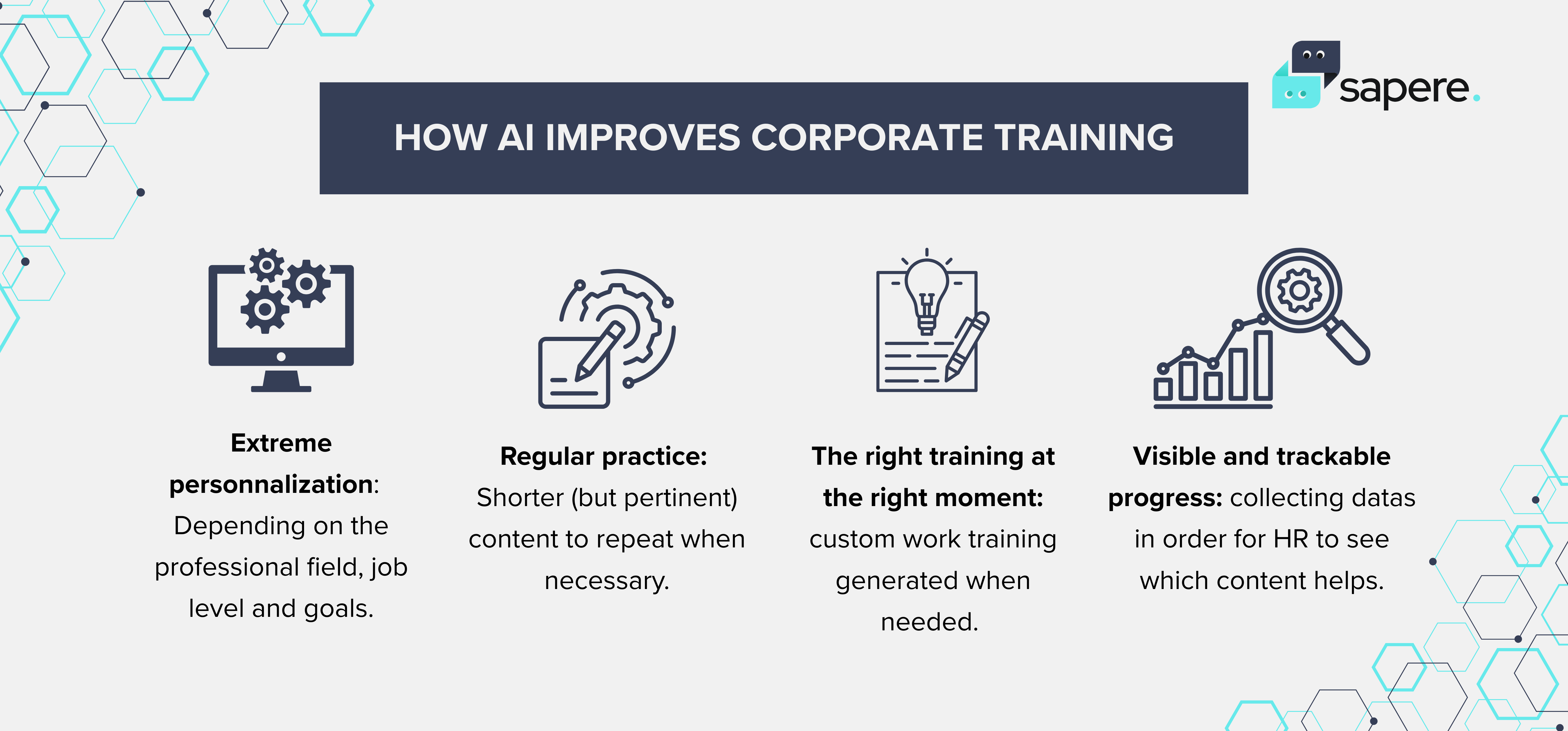
AI can quickly personalize content and adjust it based on: level, target goals, employee role, professional sector, a useful vocabulary list, or typical workplace situations.
Take a language training example with two intermediate learners who don’t have the same needs:
Someone in customer service needs to work on scripts, listening skills, and paraphrasing.
Someone in management needs to improve speaking in meetings, nuance, and negotiation.
With an AI-driven approach, you don’t build two separate training programs: you create a pathway that adjusts to real needs and can evolve as roles and future needs change. The customer service employee can listen to dialogues inspired directly by their industry, while the manager can practice speaking through personalized role plays.
Key takeaway: personalization is no longer a “premium bespoke” option, it becomes a scalable mechanism.
More practice, more often (and in realistic contexts)
Learning isn’t just about “understanding.” It’s about repeating, correcting, reusing, making mistakes, and trying again. AI enables regular practice, especially through:
short exercises (micro-sessions),
simulations and role plays,
immediate feedback and precise corrections,
scenarios connected to daily work.
In language training, this means learners can practice responding to a customer complaint with the right tone, rephrasing a safety instruction, asking for clarification without sounding abrupt, or closing a professional exchange smoothly.
That’s exactly the type of training that’s often missing between two language classes.
More visible progress (for the learner and the company)
When training is fueled by usage data (activity, results, recurring difficulties), it becomes easier to identify:
who is progressing consistently,
who is struggling,
which skills are blocking progress,
which content truly helps.
With this data, HR teams and managers can clearly see whether training is working. The point isn’t just to track who completed the training, but to know who is improving on the targeted skills.
This learning logic (including ongoing tracking and recommendations for improvement) is already central to Sapere’s approach to language learning in professional contexts.
“Just-in-time” learning, not “just in case”
A large part of traditional training is built “in advance”: topics are taught in the hope they’ll be useful later. AI can do the opposite —deliver the right content at the right moment: before a presentation, after a recurring mistake, or when a need appears in the workflow.
In English learning training, someone who must present a project in English next week doesn’t need a generic module. They need to:
anticipate questions and work on specific vocabulary,
structure their message with linking words,
practice transitions,
work on the pronunciation of key terms.
In that case, AI can generate a tailor-made training sequence. This makes training far more useful… and therefore more motivating.
Languages: the best field to understand AI’s value
Why is corporate language learning such a powerful use case for understanding AI’s benefits in training? Because it combines all the requirements of effective workplace learning: gradual progression, frequent practice, meaningful feedback, job-specific context, measurable outcomes, and more.
It’s also a domain where a hybrid approach is often the winning formula: AI personalizes lessons, while the human (the teacher) guides the employee through difficulties, provides fine-grained corrections, and builds confidence (especially in speaking).
Sapere emphasizes this human + AI complementarity, rather than setting them in opposition.
Beyond languages: opening the door to other training topics
Once a company adopts an AI training mindset (personalization + practice + measurement), it becomes natural to extend it to other areas, for example:
Customer service: handling a complaint, de-escalating tension, applying a protocol, choosing the right tone.
Health & safety: understanding technical procedures, reviewing critical points, simulating risky situations.
Compliance: memorizing rules, practicing with scenarios, checking understanding.
Onboarding: learning internal tools, processes, and the company’s vocabulary.
The common thread is the same: moving from “generic content” to contextualized, measurable learning that is reinforced over time.
BONUS: Best practices to make it work
Keep a critical mindset: AI can make mistakes, oversimplify, or miss nuance. Whatever the generated content, a qualified trainer should review it before sharing it with employees. It’s also recommended to provide learners with a way to report bugs or errors.
Build short but effective training paths (even if repeated several times a year).
Use concrete, real situations employees experience every week.
Define what “success” means: what skills should be observable on the job?
Protect data: avoid entering sensitive information into tools that are not properly governed.
Think “hybrid”: AI strengthens practice, but humans remain essential for quality and adoption.
AI doesn’t improve employee training because it “does everything for you.” It improves training because it makes it more relevant, easier to understand, and more useful.
Languages are an excellent place to start: it’s concrete, measurable, and directly useful at work. And once the dynamic is in place, the door opens to other professional learning: train better, faster, and more sustainably.
Similar Tags
Popular Keywords
Related Posts