
Table of Contents
How to Overcome the Intermediate Plateau (CEFR Levels B1-B2)?

Sapere's team
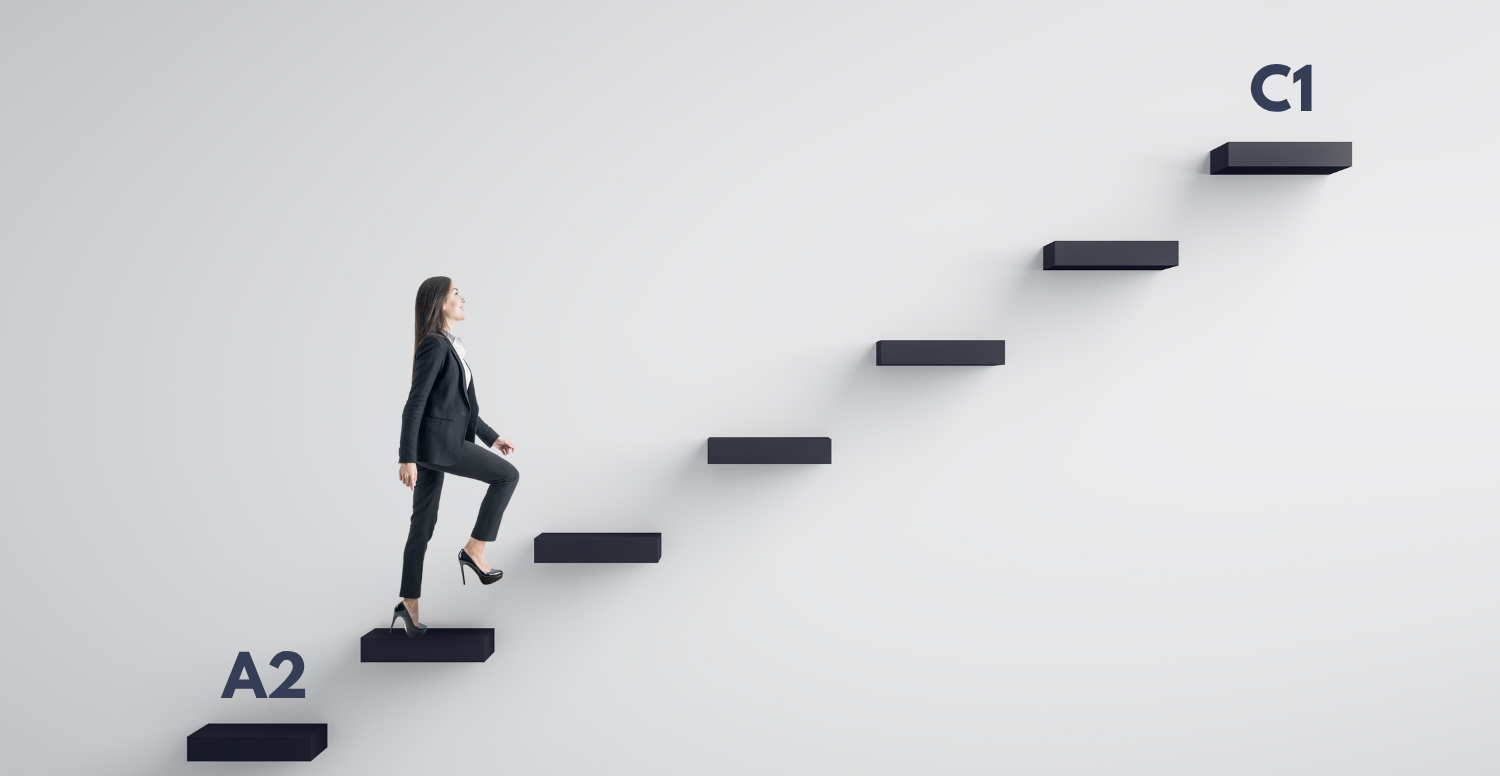
Learning a new language is often perceived as a linear ascent, where every hour of study translates into visible improvement. However, many learners reach a point where this progression seems to stagnate—a phenomenon commonly known as the "intermediate plateau." Far from being inevitable, it is a natural stage in the language acquisition process. This article explores the scientific reasons behind this plateau and proposes effective language learning methods, showing how innovative tools like Sapere can transform this period of stagnation into an opportunity for growth to improve your language level and achieve language fluency.
What is the Intermediate Plateau?
Typically occurring around the B1 and B2 levels of the Common European Framework of Reference for Languages (CEFR), the intermediate plateau manifests when initial progress in language learning slows down considerably. At the beginning, every new word or grammar rule brings a significant improvement in the ability to communicate. But once the basics are acquired (A1-A2 levels), the learner may feel "stuck." Although capable of handling daily situations, they struggle to master more complex topics, rapid speech, or specialized vocabulary. This can be a major source of frustration and demotivation.
This phenomenon is well-documented in second language acquisition. As early as 1998, Peter Skehan analyzed this plateau through the lens of cognitive psycholinguistics. He explained that the slowdown in progression is due to limited attentional capacities and the fact that learners often prioritize meaning (communication) over form (grammatical precision), which leads to stagnation. Today, this concern remains very real for second language learners, many of whom share their experiences of stagnation and seek solutions to progress.
The Scientific Causes of the Plateau
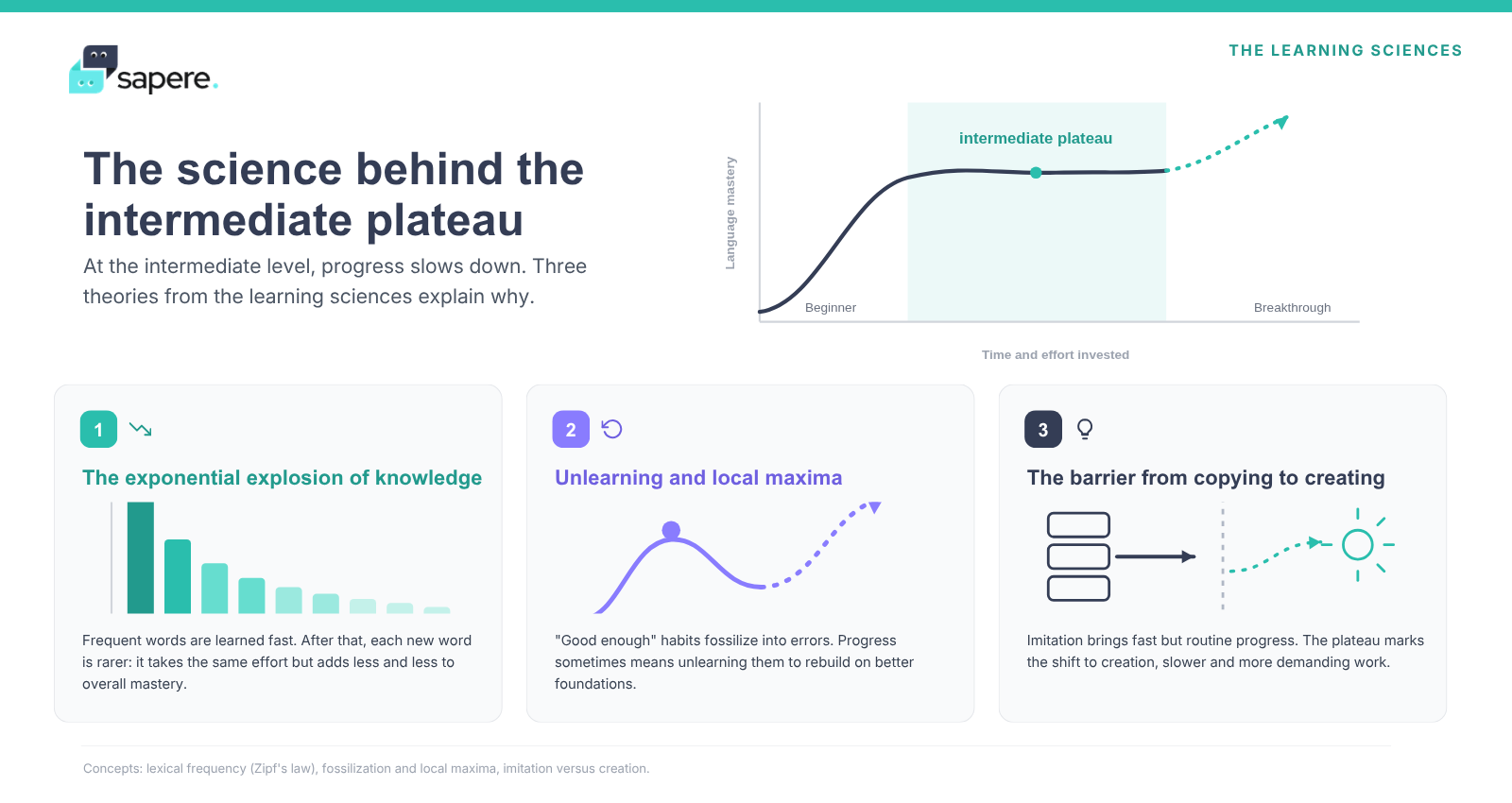
Several theories from the learning sciences explain the appearance of this intermediate plateau:
1. The Exponential Knowledge Explosion
At the start of the journey, every new word acquired is a high-frequency word, meaning it appears very often in the language. Indeed, we usually begin by learning basic vocabulary and the most commonly used words. However, at the intermediate level, most high-frequency words are already known. The learner then begins to acquire lower-frequency words, which appear less often. According to Zipf's Law, the frequency of a word's use is inversely proportional to its rank. This means that each new word learned, while requiring the same mental effort, contributes less and less to overall language mastery.
Furthermore, knowledge is not acquired once and for all. We need multiple exposures to learn a word and spaced exposures to maintain it in memory. Since rarer words are used less frequently, they take longer to become permanently anchored in our linguistic repertoire.
2. Unlearning and Local Maxima
Contrary to popular belief, learning is not always strictly additive. Sometimes, to progress, one must "unlearn" certain habits. For example, a "good enough" pronunciation or simplified grammatical patterns can become fossilized—meaning they become permanent errors that are difficult to correct because they allow for basic communication. For instance, a French learner might get used to systematically using the present tense instead of the past tense ("Hier, je vais au marché") or ignoring gender agreements ("la voiture bleu"). As long as the listener understands, the error is not penalizing for daily survival, which hinders spontaneous correction.
This automation of mediocre methods creates a "local maximum": the learner is effective at what they do, but this effectiveness prevents them from reaching a higher level without deliberate practice aimed at refining performance and rebuilding automaticity on more correct foundations.
3. The Barrier from Copying to Creation
Human beings are excellent imitators. At the beginning of learning, students progress rapidly by copying phrases, structures, and models. However, the intermediate plateau can mark the transition from imitation-based learning to learning that requires more creative problem-solving. Learning from others is fast but limited to routine situations.
Overcoming the intermediate plateau requires a deep search for solutions, which is a much slower and more laborious process. The plateau occurs when the learner must move from applying existing principles to inventing new ways of expressing themselves, which is inherently more difficult.
How Sapere Helps Surmount the Plateau
How can you move beyond the B1 and B2 levels to improve your language skills? Sapere, by relying on the principles of learning sciences, offers concrete solutions to overcome the intermediate plateau:
Spaced Repetition and Personalized Exercises
To counter the exponential explosion of knowledge and the forgetting curve, Sapere integrates spaced repetition into its personalized exercises. This scientifically proven method optimizes the moment a learner reviews information, maximizing long-term retention. By focusing on the least mastered words and structures, Sapere ensures that learning effort is directed where it is most effective, transforming the required exponential effort into targeted and manageable practice.
Conversational Agents for Oral Practice
The fossilization of errors and the transition from copying to creation are issues addressed by Sapere's conversational agents. These agents allow for fluid oral and written practice, offering instant feedback and the opportunity to engage in various role-playing scenarios. By interacting with these agents, learners can:
Break Fossilization: Immediate feedback helps identify and correct errors before they become ingrained.
Develop Creativity: Role-plays and spontaneous conversations encourage learners to formulate their own ideas, moving from imitation to autonomous and creative production.
Improve Pronunciation: Regular practice with conversational agents allows for refining speech and pronunciation in a judgment-free environment.
Adapted Content and Progress Tracking
Sapere offers individualized learning paths and detailed progress tracking. This enables deliberate practice by identifying exactly which areas need improvement—a tip often emphasized by experienced learners. By adapting content to the learner's specific level and needs, Sapere acts as an expert mentor, guiding the learner through intermediate-level challenges and helping them refine their skills where it is most needed. The progress dashboard allows learners to visualize their advancement and stay motivated, fostering active immersion and targeted practice. Those are key strategies for breaking the plateau.

Hybrid Learning: The Winning Duo with Global Lingua and Sapere
To quickly break through a plateau, we recommend hybrid learning, which combines the human expertise of Global Lingua and the technological power of Sapere. On one hand, Sapere's algorithms ensure optimal spaced repetition and constant oral practice via AI. On the other hand, Global Lingua's teachers provide cultural nuance, empathy, and personalized correction on complex points that only human interaction can offer.
This hybrid method allows for breaking the fossilization of errors through the teacher's expert eye, while maintaining a sustained learning pace with Sapere's tools. This alliance between artificial intelligence and human tutoring allows learners to definitively cross the intermediate barrier and reach the C1 level!
The intermediate plateau in language learning is a universal challenge, but it is not insurmountable. By understanding the scientific mechanisms at play—the knowledge explosion, error fossilization, and the transition to creation—learners can adopt effective learning strategies. Platforms like Sapere, by integrating spaced repetition, conversational agents, and personalized tracking, offer powerful tools to learn a language and transform this period of stagnation into a growth phase. By embracing active immersion, targeted practice, and encouraging oral and written production, learners can break this plateau and achieve their desired language fluency.
Similar Tags
Popular Keywords
Related Posts