Table of Contents
The Sapere Scale: 18 Levels to Know Exactly Where You Stand in a Language

Sapere's team

Since 2001, the Common European Framework of Reference for Languages (CEFR) has served as the global standard for assessing language proficiency. Its six levels, from A1 to C2, are familiar to most learners and institutions. But this breakdown has a limit: each CEFR level can represent months, even years, of practice. As a result, many learners feel like they're standing still, even when they're actually making real progress.
That's the problem the Sapere scale was built to solve. Developed for the Sapere.ai platform, Quebec's AI-powered language-learning platform, this scale breaks the learning journey into 18 stages instead of 6. The goal: make progress visible, measurable, and motivating, from the very first word all the way to full mastery of a language.
What Is the Sapere Scale?
The Sapere scale is a language proficiency classification system made up of 18 levels, numbered 1 to 18. Each stage corresponds to concrete, observable skills: precise vocabulary, mastered grammar structures, a specific degree of fluency in speaking and writing. Rather than telling a learner "you're B1," Sapere can tell them "you're Sapere 8," pinpointing their position much more precisely within the intermediate level itself.
This granularity isn't just an academic exercise. It's made possible by the platform's artificial intelligence, which continuously analyzes a learner's spoken and written output (pronunciation, grammar, vocabulary) to precisely locate their skills and generate exercises tailored to their exact stage.
Sapere and the CEFR: How the Two Scales Compare
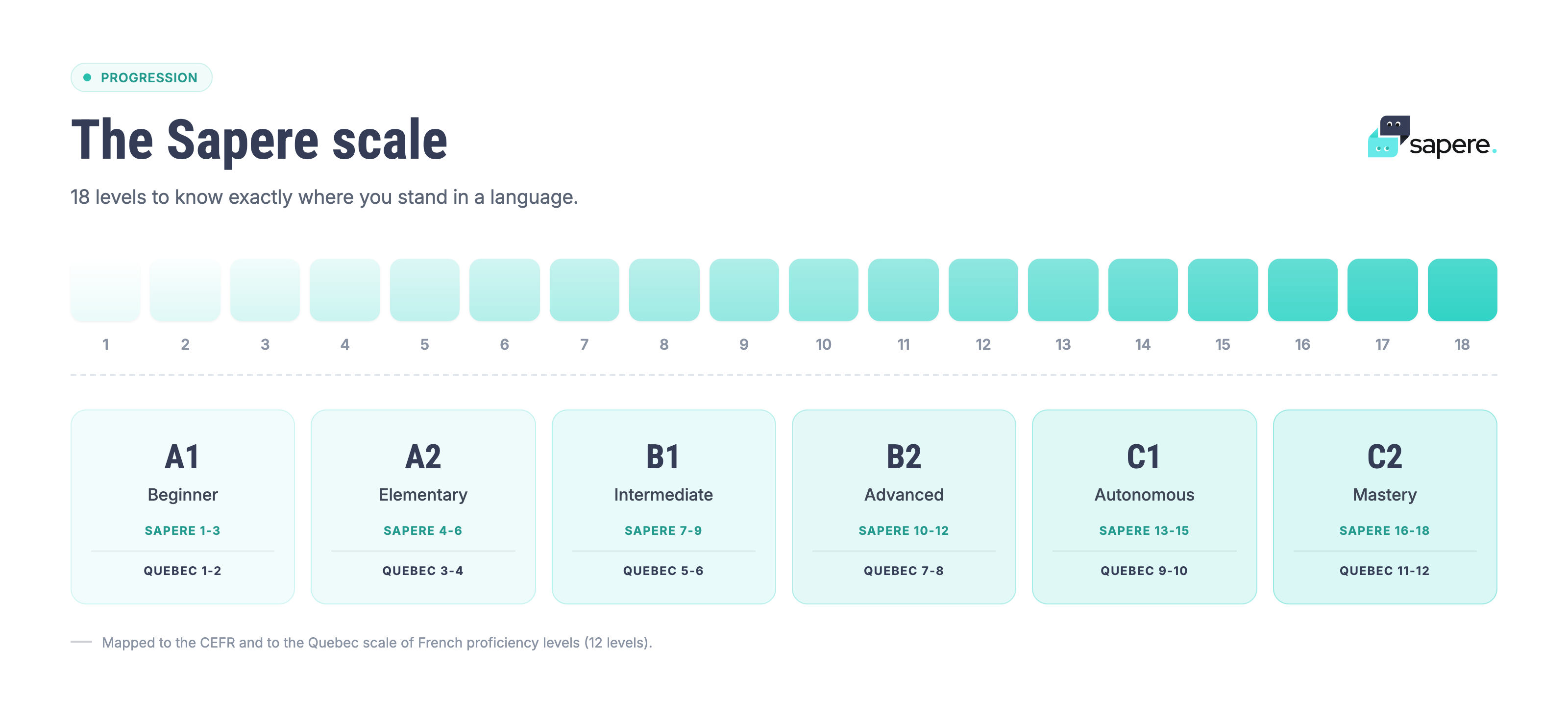
The Sapere scale doesn't replace the CEFR, it complements it. Each group of three Sapere levels corresponds to one CEFR level, preserving an internationally recognized benchmark while adding much finer day-to-day precision.
CEFR Level | Description | Corresponding Sapere Levels |
A1 | Beginner | Sapere 1 to 3 |
A2 | Elementary | Sapere 4 to 6 |
B1 | Intermediate | Sapere 7 to 9 |
B2 | Advanced | Sapere 10 to 12 |
C1 | Autonomous | Sapere 13 to 15 |
C2 | Mastery | Sapere 16 to 18 |
In practice, a learner who moves from Sapere 7 to Sapere 8 stays "B1" on the CEFR, but has just crossed a real, measurable milestone in their progress. That difference changes everything: instead of waiting months to move up a category, learners see their progress confirmed at much shorter intervals.
The Sapere scale is also more precise than Quebec's own reference scale, the Échelle québécoise des niveaux de compétence en français, which is used by the province (notably by the MIFI) to assess adult immigrants' French skills. That scale has 12 levels, grouped into three stages: beginner (1 to 4), intermediate (5 to 8), and advanced (9 to 12). By offering 18 levels rather than 12, and by applying across languages rather than French alone, Sapere pushes the granularity even further, giving learners and teachers an even sharper picture of where things stand.
Why 18 Levels Instead of 6?
The main criticism teachers and learners level at the CEFR is its low granularity. A B1 level, for example, groups together learners whose actual abilities can vary enormously: some still struggle to form complex sentences, while others already discuss abstract topics with ease. This wide range can create what's known as "invisible stagnation": the learner is genuinely progressing week after week, but nothing in their assessment confirms it, since they remain technically at the same CEFR level for a long time. Some learners even get stuck at the intermediate plateau.
By tripling the number of stages, the Sapere scale narrows the gap between two assessments. Every stage crossed becomes tangible proof of progress, which has a direct effect on long-term motivation, a decisive factor in language learning.
The Concrete Advantages of the Sapere Scale
More visible progress, and therefore more motivation
Seeing your level move from 8 to 9 is far more rewarding, and far more frequent, than waiting to move from B1 to B2. It turns learning into a series of small, regular wins rather than one distant goal.
A precise diagnosis for truly tailored content
Because the scale is finer, the platform can target exactly the skills that need reinforcing at each stage, rather than offering generic content designed for an entire CEFR level. Combined with Sapere's personalized lexical field (medical, legal, technical, business, and more), this precision makes learning directly applicable to a learner's daily life or work.
Instant feedback, aligned with the learner's real level
Sapere's artificial intelligence corrects pronunciation, grammar, and vocabulary in real time, accounting for the learner's exact stage. A correction that's relevant for a Sapere 4 isn't necessarily relevant for a Sapere 6: the 18-level scale allows for that degree of nuance.
Detailed, actionable progress tracking
Thanks to progress reports based on this scale, learners and their teacher can pinpoint exactly which areas need reinforcing between two lessons, rather than relying on a general impression of level.
A scale that stays compatible with international benchmarks
Since every group of three Sapere levels corresponds to a CEFR level, learners keep a universal reference point (useful for a resume, an immigration application, or a school enrollment) while benefiting from much finer day-to-day tracking.
A Scale Built for Humans and AI, Together
The Sapere scale truly comes into its own within the platform's hybrid model: learning solo with AI, available 24 hours a day, or in tandem with a Global Lingua teacher who calibrates, nuances, and guides the journey. AI excels at measuring, repeating, and correcting with precision and consistency. The teacher remains irreplaceable for cultural context, the finer nuances of language, and sustained motivation.
In this combined model, the 18-level scale becomes a shared language between the learner, the AI, and the teacher: everyone knows exactly where the person stands, and what's left to work on to reach the next stage.
In Summary
The Sapere scale doesn't aim to replace the CEFR, but to fill in its blind spots. By offering 18 levels instead of 6, it makes language progress more precise, more visible, and more motivating, while staying anchored to recognized international standards. Combined with artificial intelligence and the human support of a Global Lingua teacher, it offers a reference framework that's far more faithful to the reality of learning: progressive, personalized, and never static.
To discover your level on the Sapere scale, head to Sapere.ai and create your profile.
Similar Tags
Popular Keywords
Related Posts