Table of Contents
Training Bilingual Teams Faster: Learning on the Job With AI
Sapere's team

Imagine a sales manager based in Montreal who needs to present a new product to partners in Germany in six weeks. His German is intermediate — good enough for casual conversation, but not yet up to the demands of a negotiation. Traditional training would offer him generic modules on business vocabulary. AI, on the other hand, prepares him for a precise simulation of that specific meeting: the right industry context, the right stakes, the expressions expected in German business culture.
That's the difference between learning a language and learning your working language.
The Problem with Classis Corporate Language Training
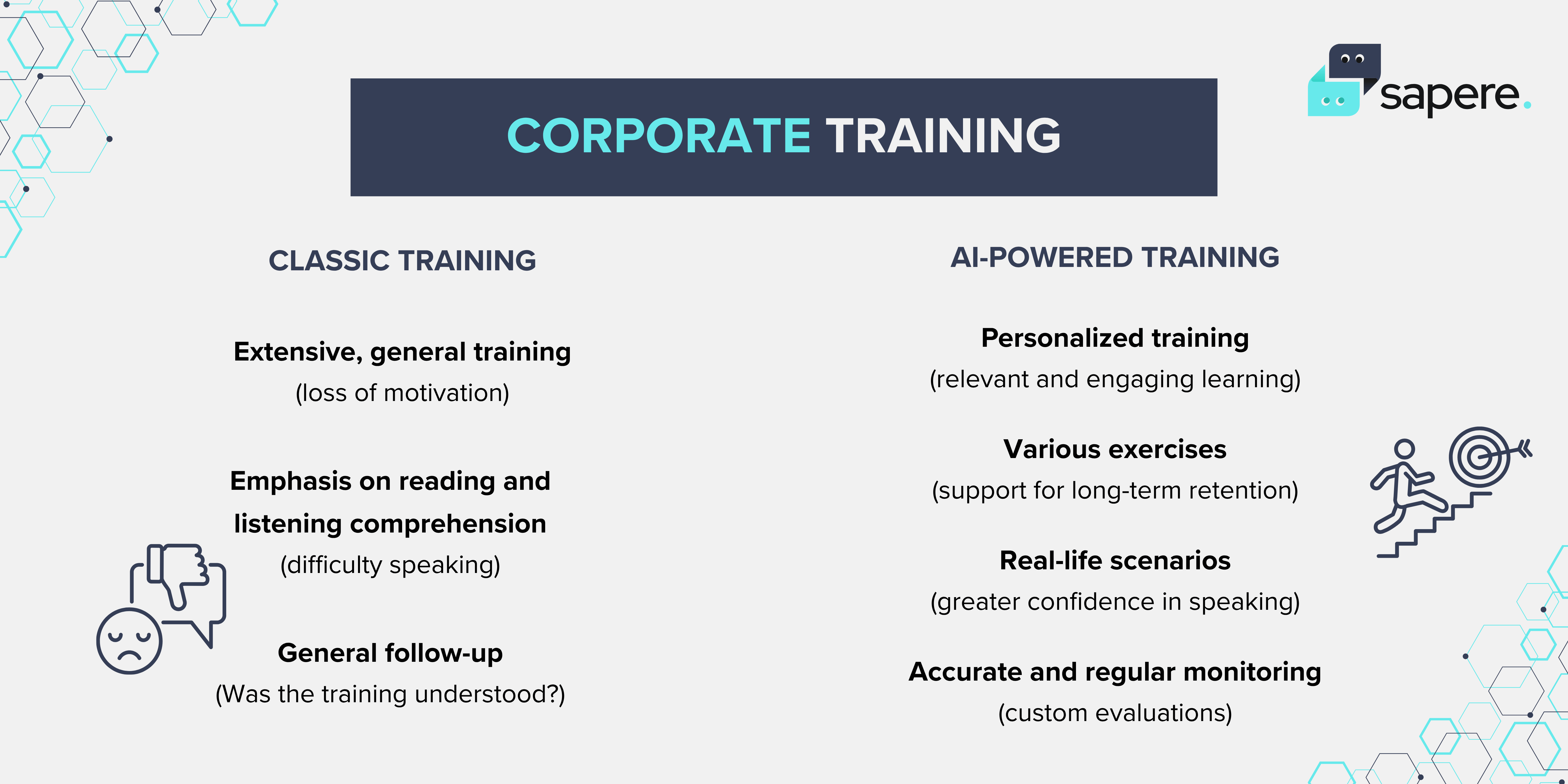
HR and L&D managers know it well: corporate language training programs have long suffered from a persistent gap between the classroom and the workplace. An employee can complete 40 hours of business English training and still freeze up when they need to write a sensitive email to a client or run a hybrid meeting with an international team.
The reasons are well documented: content is too generic, exercises too abstract, and the space to practice in real-world conditions is virtually nonexistent. Add to that the time constraint: employees simply don't have hours to dedicate to courses that don't directly address their immediate needs.
The result: large training budgets, slow progress, difficulty expressing themselves verbally, and frustration on both sides.
That's where artificial intelligence comes in!
Corporate Training: What AI Changes in Practice
AI tools (like the Sapere platform) make it possible to design language training programs that adapt to each learner's professional reality — not the other way around. With AI, employees learn exactly what they need for their role. No more cognitive overload from learning what doesn't matter.
Content Grounded in Professional Context
An AI tool can generate exercises, dialogues, and role-play scenarios based on the vocabulary, processes, and communication norms specific to an industry. A healthcare professional will learn to communicate with anglophone patients or medical teams — not order a coffee. A financial analyst will work on writing earnings commentaries or leading a quarterly call, not on tourist small talk.
Real-Time Adaptive Progression
Unlike fixed curricula, AI systems identify each learner's specific gaps — a pronunciation issue, a misunderstood grammatical structure, a register problem — and adjust the learning path accordingly. The learner is never stuck on concepts they've already mastered, nor pushed too quickly into content that's out of reach.
Realistic Simulations of Real Work Situations
This is the most significant development for operational teams. AI can play the role of a difficult client, a foreign colleague, a recruiter, or a partner in a crisis meeting. Whether through a role-play exercise or a conversational agent, it's now much easier to practice "for real." This intensive, repeated practice in near-real scenarios significantly accelerates language acquisition.
3 Ways to Learn Through Sapere's Features
Conversational Agents to Practice in Real Situations
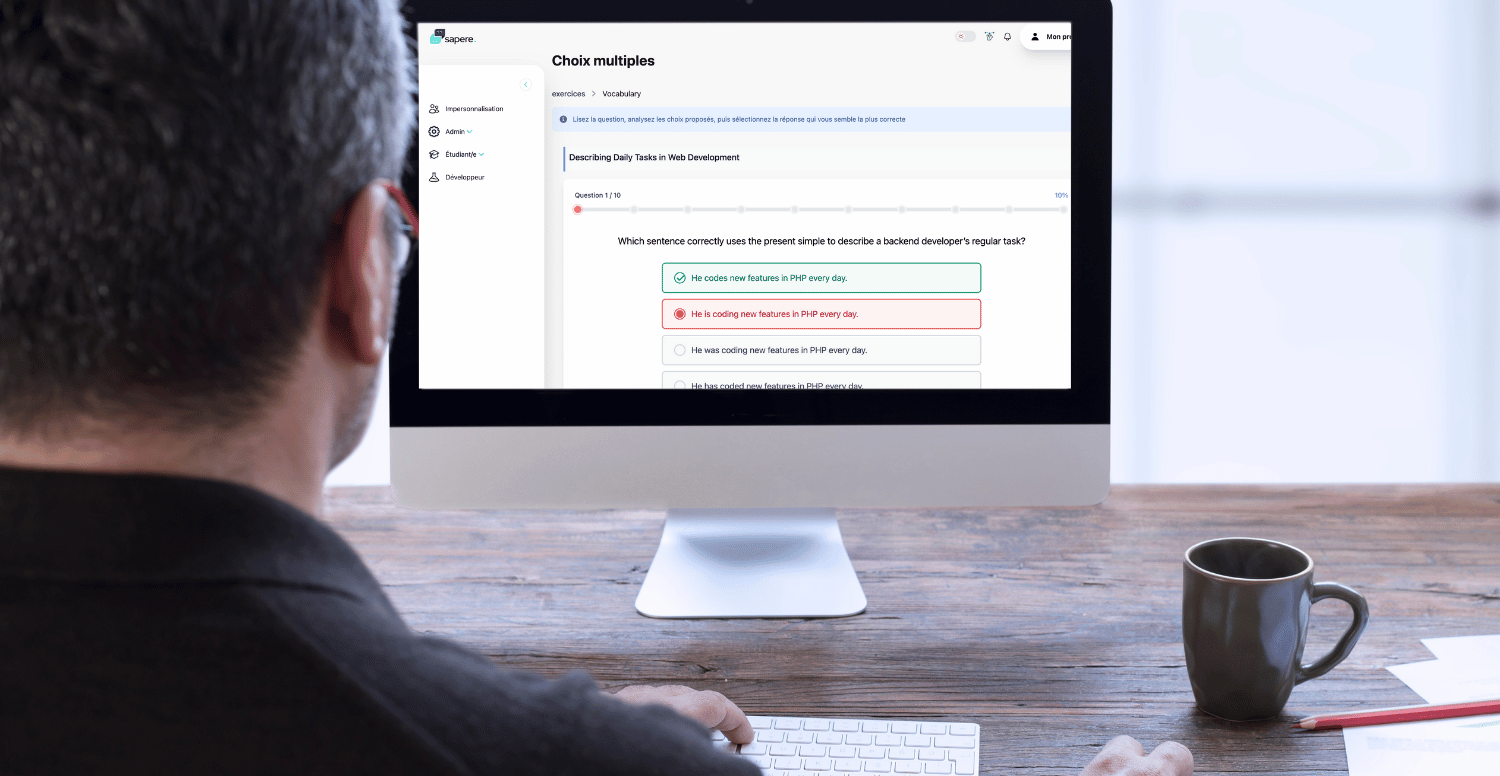
Sapere's conversational agents allow employees to train in scenarios directly tied to their role: a negotiation with a foreign client, a debrief in an international meeting, a sensitive email to write. The agent plays the counterpart, adapts to the learner's level, and provides immediate feedback on both content and form. It's real-world practice — without the risk, and without depending on a trainer's availability.
Contextual Course Material for Job-Relevant Vocabulary
Sapere automatically generates pedagogical content adapted to the learner's professional context: their industry, their responsibilities, the communication situations they encounter daily. An account manager in financial services won't follow the same path as a project manager in logistics — and that's precisely what makes learning effective. The vocabulary learned is immediately usable, not stored away for some future moment.
Custom Assessments to Measure Progress That Actually Matters
Rather than logging training hours, Sapere offers assessments calibrated to employees' real competencies. L&D managers can track concrete indicators — can this employee now lead a meeting in English? Write a report without assistance? — and adjust learning paths based on results. The built-in progress analysis gives a clear picture of what's working and what still needs reinforcing.
Bonus: Sapere's real strength lies in its hybrid model. Available 24/7, the Sapere platform can also be used alongside a teacher during online sessions for faster progress. For best results, we recommend combining human expertise with AI-personalized content.
For HR and L&D Managers: Where to Start?
Integrating AI into a language training strategy doesn't mean starting from scratch. Here are some practical steps:
Map real language needs. What communication situations are causing friction in your teams today? Email, presentations, negotiations, technical documentation? These situations become the foundation for training scenarios.
Choose tools that fit into existing workflows. The best solutions are ones employees can use in micro-sessions, directly from their computer or phone — without blocking out half-days.
Combine AI with human support. AI excels at intensive practice and instant feedback. Human trainers remain essential for cultural nuance, long-term motivation, and personalized coaching. That's why Sapere can be used in tandem with a Global Lingua language teacher or an in-house corporate trainer.
Measure the right indicators. Rather than counting training hours, track linguistic competency indicators through assessments. On Sapere, employees can check their level through a personalized evaluation whose results are visible to the manager.
The Real Challenge: Closing the Gap Between Training and Performance
The true promise of AI applied to language training isn't to replace languages with automatic translators. It's to reduce the time between when an employee starts learning and when they're operational in their working language.
In a context where companies recruit talent across multiple countries, operate in several languages, and collaborate in real time across time zones, this acceleration isn't a luxury. It's a direct competitive advantage.
Building bilingual teams faster is possible — as long as learning happens in action, and with the right tools to get there.
Interested in exploring how to integrate AI-based language training into your organization? Contact our team.
Similar Tags
Popular Keywords
Related Posts